

Советы по контролю семян для обеспечения воспроизводимых результатов

Ever wondered why your favorite images disappear when you refresh the page? It’s frustrating to lose a perfect image because the variables changed. You’re not alone in wanting consistent results in your creative work.
Learning контроль семени порно с помощью ИИ is key for those who need precise results. By setting specific numbers, you can avoid endless tries. This guide will teach you how to get predictable and stable results every time.
Key Takeaways
- Understand the role of numerical values in image generation.
- Learn how to lock variables to ensure consistent visual outputs.
- Stop relying on luck and start managing your creative process.
- Discover methods to replicate successful designs with ease.
- Gain full command over your generative workflow for better efficiency.
Understanding the Role of Seeds in AI Image Generation
At the heart of every AI-generated image is a seed. This number sets the starting point for the generation process. Without a seed, the model starts randomly, making reproducibility hard to achieve.
This process is similar to the temperature in Large Language Models (LLMs). While temperature controls text randomness, the seed is the foundational anchor for image diffusion. A random seed introduces a lot of variance, changing the image’s composition, освещение, и стиль.
For creators aiming for consistent aesthetics, using a fixed seed is crucial. A fixed seed keeps the noise pattern constant. This allows for refining prompts while maintaining the image’s core structure. This control is key for reproducibility in professional settings.
| Особенность | Random Seed | Fixed Seed |
|---|---|---|
| Output Consistency | Low (High Variance) | High (Predictable) |
| Creative Control | Limited | Advanced |
| Use Case | Exploration | Refinement |
| Workflow Impact | Unpredictable | Stable |
Grasping these core mechanics helps manage the randomness in generative models. Mastering the seed lets you direct the model toward your vision. This skill distinguishes casual users from those who consistently produce high-quality visuals.
Mastering AI Porn Seed Control for Consistent Results
Learning to control AI porn seed is key to keeping your scenes the same. If the software picks a random seed, it can introduce random changes. These changes can mess up your vision by altering character looks or backgrounds.
By setting a fixed seed, ты stabilize the sampling step. This makes the model stick to a certain path. It’s crucial for keeping things the same in every version. When the temperature is above zero, a fixed seed keeps your settings steady.
Using a fixed seed has many benefits for your work:
- Precise Character Retention: Keeps facial features and body shapes the same in all prompts.
- Predictable Composition: Makes sure the scene layout doesn’t change unexpectedly.
- Iterative Refinement: Lets you adjust specific parts without changing the overall image.
Getting consistent results is what professionals aim for. Without good контроль семени порно с помощью ИИ, your work might change too much. Once you get the hang of it, you can make high-quality images every time.
Setting Up Your Environment for Maximum Reproducibility
Getting consistent results in AI generation begins with a solid technical base. By controlling your local environment, you reduce the impact of outside factors that can cause unexpected changes. Proper environment management is key to long-term reproducibility in your creative work.
Computers handle math in a way that can lead to small errors. These errors can grow when your hardware or software changes. This means you might get different images from the same seed.
Configuring Stable Diffusion WebUI Settings
To keep results consistent, standardize your WebUI settings. Make sure your precision settings stay the same every time. Using the same floating-point precision, like FP16 or BF16, makes calculations more predictable.
Don’t change your optimization arguments often. If you use flags like –xformers or –medvram, keep them the same in your startup script. These settings affect how the GPU handles data, and changing them can ruin your ability to replicate results.
Managing Model Checkpoints and LoRA Weights
Your model checkpoints and LoRA weights are crucial. Always note the exact hash of the model you use. A small change to a model file can destroy your reproducibility efforts.
Have a special folder for your stable assets to avoid accidental changes. When loading a LoRA, make sure the weight value is set and saved in your metadata. Treating your models and weights as unchangeable assets helps you achieve consistent, high-quality results.
Step One: Locking the Seed for Base Image Generation
Getting perfect consistency in AI art starts with locking your seed. Using default settings means the software changes every time you click generate. By controlling this number, your base image stays the same while you work on other parts.
Identifying the Seed Field in Your Interface
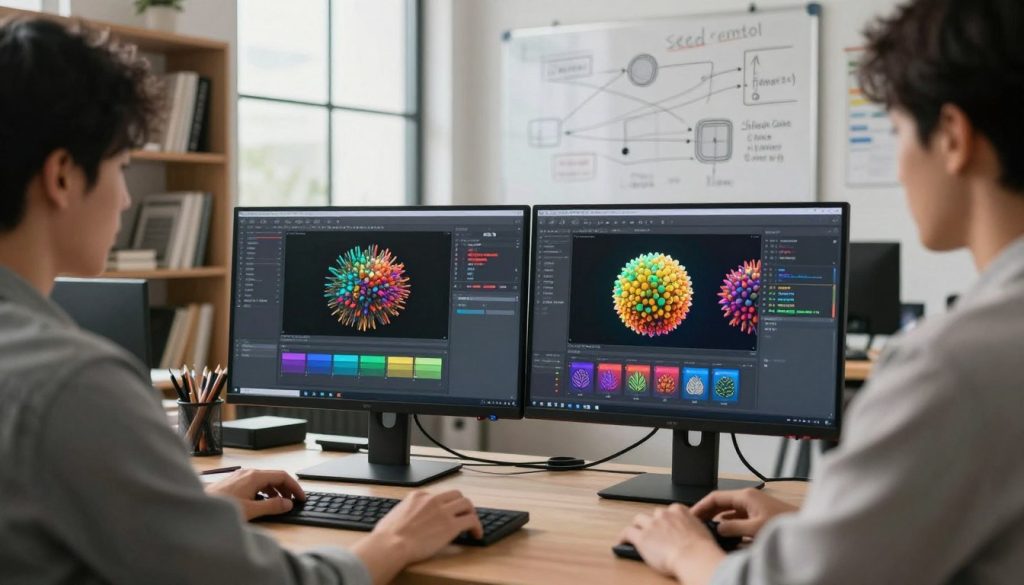
Interfaces like Automatic1111 or ComfyUI have a seed box near the prompt area. This box is usually set to “-1,” which means a random seed is used each time. To keep your generation the same, replace this with a specific number, like “123456789.”
With a fixed number, the same base image is made every time. This is key for контроль семени порно с помощью ИИ. It lets you change your prompt or LoRA weights without the image changing unexpectedly.
Why Random Seeds Disrupt Your Workflow
Random seeds add noise, making it hard to work on a single idea. Setting the temperature to zero makes the process deterministic. Without this, your work is more about luck than skill.
“Reproducibility is the bridge between a lucky accident and a professional workflow; without a fixed seed, you are merely guessing.”
Here’s why a fixed seed is better for detailed projects:
| Особенность | Random Seed (-1) | Fixed Seed (Integer) |
|---|---|---|
| Consistency | Low | High |
| Iterative Refinement | Difficult | Seamless |
| Workflow Control | Minimal | Total |
Mastering контроль семени порно с помощью ИИ means no more lost perfect images. Keep track of your successful seeds to improve over time. This simple step makes your art more highly predictable.
Step Two: Utilizing Noise Offsets for Lighting Consistency
Getting perfect lighting in AI generations is more than just a fixed seed. Modern systems often mix requests together. This makes the system seem random, even with the same prompts. It’s hard to keep consistency across many runs because of this.
The Impact of Noise on Image Variation
Noise is the base for your image. Even a small change in noise can greatly alter your image’s lighting. Small changes in the start can lead to big differences in shadows and light.
“True creative control in generative art comes from the ability to stabilize the chaotic nature of latent diffusion models.”
Knowing how noise affects your image is key. By controlling the noise offset, you can keep the lighting stable. This ensures your consistency stays the same, no matter how the system processes your requests.
Adjusting Noise Multipliers for Stable Outputs
To get stable outputs, you need to adjust your noise multipliers. These settings control how much change the model can make. Lower values mean more predictable results, while higher values offer more creativity but less stability.
| Noise Multiplier | Stability Level | Visual Impact |
|---|---|---|
| 0.05 – 0.10 | High | Minimal lighting shifts |
| 0.15 – 0.25 | Medium | Balanced variation |
| 0.30+ | Low | Significant lighting changes |
Finding the right balance is crucial for professional work. By adjusting these multipliers, you keep your consistency in check. This ensures a cohesive and polished final product. Always test your settings in small batches to make sure your lighting stays stable before a big project.
Step Three: Implementing Fixed Samplers and Step Counts
Getting perfect reproducibility is a journey, not a destination. To keep your outputs the same every time, you need to control every detail. Fixing your sampler and step count helps remove the random changes that can mess up your work.
Choosing Between Euler A and DPM++ SDE
The sampler you pick is the heart of your image-making process. Euler A is fast and great for soft, artistic looks. But, it might change too much if you increase the step count too much.
DPM++ SDE is more structured. It’s best for keeping details sharp and scenes intact. Your choice should match your vision for the final image.
- Euler A: Great for quick, artistic styles.
- DPM++ SDE: Perfect for detailed, sharp scenes.
- Consistency: Keep your sampler the same once you like the look.
| Sampler Type | Best Use Case | Stability Level |
|---|---|---|
| Euler A | Artistic/Soft | Moderate |
| DPM++ SDE | Detailed/Sharp | High |
| UniPC | Fast/Balanced | High |
How Step Counts Influence Final Composition
The number of steps affects how detailed the AI makes the image. Too few steps can make it blurry. Too many can cause it to look over-processed. Finding the right balance is crucial.
Locking your step count means the AI’s refinement process stays the same every time. This lets you play with other aspects, like prompts, without worrying about changes in the image’s structure. Consistency is the key to perfecting your art.
Step Four: Managing Prompt Weighting and Syntax
Learning to structure your prompts is key for keeping your projects looking the same. Even small changes in how you ask can mess up the final look. Precise syntax is like a guide for the AI, making sure your main subject stays in focus.
Using Brackets for Precise Emphasis
You can change how much weight certain words get in AI tools by using brackets. For example, (keyword:1.2) tells the model to focus more on that word. This is crucial for keeping your visuals consistent, especially when you want to highlight certain parts like clothes or lighting.
“The secret to great AI art is not just the prompt, but the weight you give to every single word in your sequence.”
When working with Jupyter Notebooks, be extra careful. These tools can run cells out of order, messing up your prompts. Make sure your cells execute in the right sequence to keep your consistency high.
Maintaining Consistency Across Different Resolutions
Scaling up images can introduce unwanted changes or artifacts. To avoid this, keep your prompt syntax tight. This way, the AI won’t add extra details just because the image is bigger. Locking your prompt structure ensures the subject stays the same, no matter the resolution.
If your subject changes with the resolution, try simplifying your prompt. Fewer modifiers can help keep things consistent across different sizes. Clear and weighted instructions help your vision stay true from start to finish.
Step Five: Leveraging ControlNet for Structural Reproducibility
ControlNet is key for keeping poses the same in many images. Unlike usual methods, it focuses on the spatial arrangement of subjects. Learning this skill is crucial for top-notch контроль семени порно с помощью ИИ.

Applying Canny and Depth Maps to Lock Poses
The Canny edge detector is vital for getting the exact shape of a character. It pulls out the edges from a reference image. This makes the model stick to the original shape, even with other changes.
Depth maps work by showing the three-dimensional layout of your scene. They’re great for keeping characters and backgrounds at the right distance. This helps keep complex scenes looking good without falling apart.
Combining ControlNet with Fixed Seeds
Using ControlNet with a fixed seed gives you the best stability. ControlNet handles the shape, and the fixed seed keeps the texture and lighting patterns the same. This combo is the key to reliable контроль семени порно с помощью ИИ.
With these tools together, you have unprecedented authority over your work. You don’t have to hope for the right pose anymore. You can predict your results, saving time and reducing stress.
Advanced Techniques for Character Consistency
When basic methods don’t work, advanced tools offer the precision you need. To keep a character’s look consistent over time, you often need more than just seed management.
Training Custom Embeddings for Specific Subjects
Training custom embeddings is a powerful way to keep a character’s look consistent. This method, known as Textual Inversion, teaches the model a specific look using a few reference images.
By creating a unique token for your subject, you make sure the AI always shows the same look. This reliable approach helps avoid the issues that come from just using prompts.
Using Regional Prompter for Complex Scenes
Handling multiple subjects in one frame can lead to color bleeding or mixed features. Regional Prompter fixes this by letting you split your canvas into areas, each with its own prompt.
This method is key for keeping things consistent in scenes with complex backgrounds or secondary objects. By focusing on the character in one area, you keep their identity intact. Precise control over these areas ensures your project stays coherent and professional.
Troubleshooting Common Reproducibility Failures
Even with the perfect settings, you might still face unexpected results. These can make it hard to achieve reproducibility. When your images don’t match what you expected, the problem might be hidden in your software.
System-level issues can mess up even the best plans. By finding and fixing these problems, you can get back to creating smoothly.
Identifying Hardware-Related Variance
Different graphics cards can handle math slightly differently. Switching from an NVIDIA RTX 30-series to a 40-series card might change your images a bit.
These changes happen because of how different cards do floating-point calculations. To keep your results consistent, use the same precision settings on all devices. Stick to FP16 or FP32.
Also, make sure your drivers are up to date. Old drivers can cause problems that mess up your images.
Correcting VAE Mismatches and Color Shifts
A common problem is a VAE mismatch. The VAE turns latent data into images you can see.
If your VAE doesn’t match the model you’re using, your images might look off. Always check that your VAE settings match the model’s needs.
Fixing these issues often means downloading the right VAE file. Make sure it’s the correct one and selected in your settings. This ensures your images look right and are reproducible.
| Issue | Primary Cause | Recommended Fix |
|---|---|---|
| Color Desaturation | Missing or wrong VAE | Load the correct VAE file |
| Seed Mismatch | Hardware precision | Set fixed FP16/FP32 mode |
| Артефакты | Outdated drivers | Update GPU drivers |
| Noise Variance | Sampler instability | Switch to a stable sampler |
Best Practices for Documenting Your Generation Parameters
To achieve lasting consistency in your projects, treat your generation logs as key assets. Many creators miss the importance of a structured history. This habit makes the difference between hobbyists and professionals.
By recording your technical choices, you keep your creative process organized and repeatable. This ensures your work remains consistent over time.
Creating Metadata Logs for Future Reference
Metadata logs and version control are critical for tracking changes in your generative projects. Saving your generation parameters creates a roadmap for future use. This prevents the frustration of losing a perfect configuration.
Store your prompts, seed numbers, and model versions in one place. Use a simple spreadsheet or a dedicated project management tool. This maintains consistency across different iterations. It also helps troubleshoot issues if an output doesn’t meet expectations.
Sharing Settings Within the Community
Sharing your settings within the community fosters collaboration. Clear documentation helps others understand your workflow and artistic choices. This transparency leads to better feedback and innovation.
Always share the specific model checkpoint, LoRA weights, and sampler settings. This allows others to achieve similar results, reinforcing the consistency of the community’s knowledge. Documentation is the hallmark of a professional workflow, connecting individual experimentation with shared success.
| Documentation Method | Простота использования | Data Depth | Best For |
|---|---|---|---|
| Spreadsheet Logs | High | Moderate | Quick tracking |
| Version Control (Git) | Low | Very High | Complex projects |
| Metadata Sidecars | Very High | High | Automated workflows |
| Community Wikis | Moderate | High | Collaborative sharing |
Conclusion
To achieve high reproducibility, you need a structured digital workspace. Сейчас, you have the skills to move from random tries to professional work.
Tools like Stable Diffusion give you great creative power. By controlling key variables, you can make your work reliable and consistent. This means your artistic vision stays true in every project.
Improving your workflow takes patience and practice. Keep trying out different settings and methods to see their effects. Building a collection of successful settings will make your work easier over time.
Join the AI community to share your discoveries and learn from others. Your input helps expand what generative tools can do. Keep exploring and enjoy the precision in your creative work.
FAQ
What is a seed and why does it matter for reproducibility?
A seed is a starting point for AI’s random number generation. Using the same seed ensures consistent images. This is crucial for maintaining reproducibility.
How does ai porn seed control help in maintaining character consistency?
Ai porn seed control locks the AI’s focus on the character’s structure. This prevents unwanted changes, ensuring consistent images.
What is the best way to set up my Stable Diffusion WebUI for consistent results?
Use a dedicated interface like AUTOMATIC1111 and keep your model and VAE up to date. Managing LoRA weights carefully prevents style changes.
Why do my images look different even when I use the same seed?
Changes in samplers, resolution, or step counts can cause differences. Hardware variance or VAE mismatches can also affect your images.
How do noise multipliers and offsets affect lighting?
Adjusting noise multipliers and offsets helps maintain consistent lighting. This prevents images from being too dark or too bright.
Can ControlNet be used alongside seed control?
Да, using ControlNet with a fixed seed gives you total control. ControlNet locks the pose and arrangement, while the seed handles the image’s “DNA”.
What are metadata logs and why should I use them?
Metadata logs record every setting used in image creation. They help you share settings and reproduce your best work later.
What is the benefit of using Regional Prompter for complex scenes?
Regional Prompter divides the canvas into sections for different prompts. This ensures consistency in complex scenes with multiple characters or objects.