

Run It Twice: Why the Same Photo Undresses Differently Every Time (2026)
Run the same photo through the undress tool twice and you will get two different results. Not a better one and a worse one on purpose — two different ones, because each run is a fresh generation. The photo is the same, the tool is the same, and the result still changes. That is not a bug you can report and it is not a setting you can switch off. It is how the tool works, and once you accept it, the second run stops being a surprise and starts being a tool: the cheapest test in the whole undress workflow, at 21 credits a run.
Quick verdict: Run the same photo twice before you decide anything. Two runs cost 42 credits, about $0.84 on the $19.99 pack and about $0.50 on the $59.99 pack, and they tell you more than any guide can: whether the photo is the problem, whether the result is stable enough to trust, and which of the two versions is worth keeping, because the second run is the test, not the first, in every pair you compare.
Contents:
- The one-sentence version
- What “run it twice” actually means
- Why the two results are never identical
- The two-run test: how to compare
- When to run it a third time
- What to change between runs
- Notes: making the second run teach you something
- What two runs actually cost
- What running twice cannot do
- Consent and the rules
- FAQ
| Approach | Cost | What you learn |
|---|---|---|
| One run, accept it | 21 credits | Nothing — one sample proves nothing |
| Two runs, same photo | 42 credits | Whether the result is stable |
| Three runs, same photo | 63 credits | Which version is the outlier |
| Two runs, then one edit | 63 credits | Whether the winner is fixable |
| Five runs, hoping for perfect | 105 credits | Only that hope is expensive |
1. The one-sentence version
Run the same photo twice, compare the two results side by side, and keep the better one — because a single run tells you what the tool did once, and two runs tell you what the tool does with this photo. The first run is a sample of one. The second run is the beginning of a pattern. If the two results agree, the photo is probably a good input and the result is probably trustworthy. If they disagree wildly, the photo is probably a hard input, and no single run of it will ever be reliable.
This is the whole method, and it costs 42 credits. Everything else in this guide is detail: how to compare, when to stop, and what to change. But the method itself fits in one sentence, and if you remember nothing else, remember this: never judge a photo, a tool, or a result on one run.
2. What “run it twice” actually means
It means the same photo, the same tool, twice in a row, with nothing changed between the runs. Do not crop the photo between runs. Do not switch to a different photo. Do not change any setting. Change nothing, and watch what changes anyway. That is the point: the difference between the two results is the tool’s own variation, and you cannot see it until you hold everything else still.
It does not mean running two different photos and comparing them. Two different photos differ in a hundred ways — light, поза, фон, одежда, resolution — and the comparison tells you nothing about either photo. One photo, twice. That is the whole discipline, and it is harder than it sounds, because the temptation after a disappointing first run is to change the photo instead of testing it.
3. Why the two results are never identical
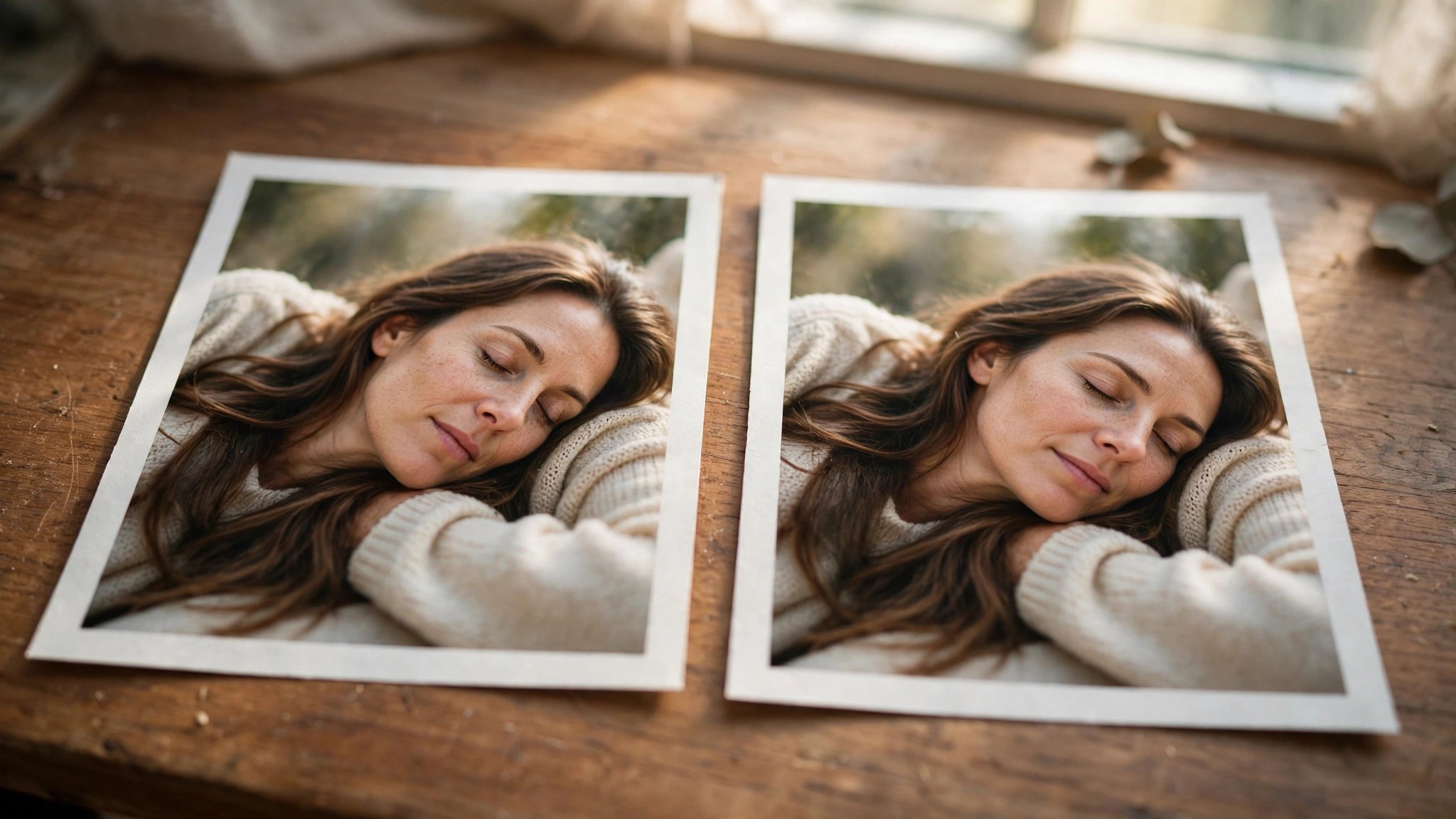
Each run is a fresh generation. The tool does not copy its last answer; it draws a new one from the same photo, and a new drawing is never exactly the old one. The broad shapes usually agree — the pose, the framing, the composition — because those come from the photo. The details do not: the edges, the shading, the small shapes where the tool had to guess. That is where the two runs diverge, and that is where you should look.
This is not something you can switch off, and there is no setting that makes two runs identical. Anyone who tells you otherwise is selling you a setting that does not exist. What you can do is use the variation instead of fighting it: run twice, keep the better draw, and treat the difference between the two as information about the photo, not as a failure of the tool.
One thing the variation does not mean: it does not mean the second run is better. The second run is just as likely to be worse. People remember the times the second run saved them and forget the times it made things worse, because the saved run is the one they kept. Expect the second run to be different, not better, and you will never be disappointed by it.
4. The two-run test: how to compare
Put the two results side by side and check five things, in this order. First, the overall shape: does the body in each result match the pose in the photo? Second, the edges: are the outlines clean, or do they wobble and smear? Third, the light: does the shading in each result match the light in the photo, or does one of them invent light that is not there? Fourth, the hands and feet, if they are visible: are they shaped like hands and feet, or like guesses? Fifth, the background: did the tool leave it alone, or did it repaint it?
Score each result on those five checks, and keep the one that passes more of them. Do not pick by feeling. Feeling picks the brighter image, or the first one you saw, or the one you want to be true. Five checks pick the better result, and five checks take about a minute.
If the two results pass the same number of checks, pick the one whose failures are easiest to fix. A bad edge can be cropped. Bad light cannot. A smeared background can be ignored if the subject is good. A wrong pose cannot be fixed at all. The winner is not the prettier result; it is the result with the most fixable problems.
5. When to run it a third time
Run it a third time when the first two disagree so much that you cannot tell which one is the outlier. Two results that both look wrong in different ways tell you the photo is hard, but they do not tell you whether either wrongness is typical. A third run breaks the tie: if two of the three agree, the third is the outlier, and you keep one of the agreeing pair.
Do not run it a third time because you are hoping for a perfect one. Three runs cost 63 credits, about $1.26 and about $0.76, and hope is not a plan. If the first two runs are both bad in the same way — the same wrong shape, the same smeared edge — the third run will almost certainly be bad in the same way too, because the problem is the photo, not the draw. Change the photo, not the run count.
The stopping rule is simple: two runs to compare, a third to break a tie, and never more than three on the same photo. Five runs cost 105 credits, about $2.10 and about $1.26, and five runs of a bad photo produce five bad results and one empty balance. The photo is the input. If the input is wrong, no number of runs fixes it.
6. What to change between runs
Nothing, for the first two runs. That is the rule from section 2, and it matters most here: if you change something between run one and run two, you will never know whether the difference came from your change or from the tool’s own variation. Hold everything still, get your two samples, and only then start changing things.
After the two-run test, change one thing at a time. The most useful first change is usually the crop: cut away background clutter and give the tool a tighter frame around the subject, then run twice again on the cropped version. The second most useful change is the photo itself: pick a different photo of the same person, with clearer light and a simpler background, and run the two-run test on that one. Compare the pairs, not the singles.
What not to change: do not change two things at once. A new photo and a new crop in the same step tells you nothing, because if the result improves you will not know which change did it, and if it gets worse you will not know which change to undo. One change, two runs, compare. Slow, boring, and the only method that actually teaches you anything.
7. Notes: making the second run teach you something
Write down what happened. Not a diary — three lines. Photo name, what the two runs did differently, and which one you kept. That is enough. After ten photos you will have ten three-line notes, and the pattern will be obvious: which kinds of photos give stable results, which kinds give wild ones, and which kinds fail the same way every time.
The notes are worth more than the runs, because the runs are spent and the notes are not. A note that says “busy background, two runs disagreed on the edges” saves you 42 credits next time, because you will crop the background before you run. A note that says “plain wall, two runs nearly identical” tells you which photos to reach for first. Nobody remembers ten runs. Everybody can read ten lines.
Keep the kept result and the note together. A folder of kept results with no notes is a folder of pictures you cannot reproduce. A folder of kept results with three-line notes is a working method, and a working method is what turns 21 credits a run from a gamble into a process.
What two runs actually cost
Prices checked 13 Nov 2026. One undress costs 21 credits, about $0.42 on the $19.99 pack (1000 credits, $0.020 a credit) and about $0.25 on the $59.99 pack (5000 credits, $0.012 a credit). Two runs cost 42 credits, about $0.84 and about $0.50. Three runs cost 63 credits, about $1.26 and about $0.76. Two runs plus one image edit on the winner costs 42 plus 21, which is 63 credits, about $1.26 and about $0.76.
Five runs of the same photo cost 105 credits, about $2.10 and about $1.26 — more than two full two-run tests on two different photos, and less useful than either. The packs cost $19.99 для 1000 credits and $59.99 для 5000 credits, paid once and credited immediately, with no automatic renewal. The annual packs cost $119.88 и $359.88, paid once and issued monthly over 12 months. A free tier is available with no sign-up required, so the first test can cost nothing at all.
What running twice cannot do
Running twice cannot fix a bad photo. If the source photo is dark, blurry, or crowded, two runs give you two versions of the same problem, and a third run gives you a third. The fix is a better photo, not a better draw, and no number of runs changes that.
Running twice cannot promise a good result. It can only tell you whether the results you are getting are stable. A photo that produces two equally bad results is stable and bad, and stability is not quality. Do not mistake agreement for goodness: two runs can agree and still both be wrong.
Running twice cannot tell you what the tool will do tomorrow. Each run is fresh, and freshness cuts both ways: the photo that ran well twice today might run differently next week, because the draw is new every time. The two-run test is a test of this photo, right now — not a guarantee, and not a rating you can carry to the next photo.
Consent and the rules
Only undress photos of yourself, or of a consenting adult who has agreed to this specific use. Running the same photo twice does not create permission, and a second run is not a second chance to get consent. Ask first, and accept no as a complete answer.
Everyone in every image must be a fictional adult or a real consenting adult aged 18 или старше. This guide is about testing your own photos, not about finding other people’s photos to run. When in doubt, the answer is no.
FAQ
Why did the same photo give me two different undress results?
Because each run is a fresh generation. The tool draws a new result from the same photo every time, so the broad shapes usually agree and the details differ. That variation is normal, not a fault, and it is why the two-run test exists.
Is the second run better than the first?
Not necessarily. The second run is just as likely to be worse. Run twice to compare, not to improve — keep whichever of the two passes more of the five checks, and do not assume the later run is the better one.
How many times should I run the same photo?
Twice to compare, a third time only to break a tie when the first two disagree wildly. Never more than three on the same photo: five runs cost 105 credits and a bad photo stays bad no matter how many times you run it.
What should I change if both runs are bad?
Change the photo, not the run count. If both runs fail the same way, the problem is the input. Crop away background clutter first, then try a different photo with clearer light and a simpler background, and run the two-run test on that one.
Does running twice cost double?
Да. Each run costs 21 credits, so two runs cost 42 credits, about $0.84 on the $19.99 pack and about $0.50 on the $59.99 pack. It is the cheapest test in the workflow, and it is cheaper than running five times hoping for a perfect draw.
Can I use the two-run test on other tools?
Да, the idea travels: any tool that generates a fresh result each time can be tested the same way. Run the same input twice, compare on fixed checks, keep the better one, and change one thing at a time. The prices differ per tool — a still image costs 6 credits, a face swap costs 26 — but the method is the same.
Keep reading: What to Expect From an Undress (and What Not To): Managing Expectations · Your Camera Roll Is the Input: Finding Undress-Ready Photos You Already Took · After the Undress: Cleaning Up, Cropping & Finishing the Result