

Guía de solución de problemas: renderizados lentos, Artefactos & Tiempos de cola

Ever felt like your creative work stops just when you’re almost done? It’s really frustrating when your system can’t keep up. Instead of seeing your work come to life, you’re stuck with a frozen screen.
Slow render speed y errors can really slow you down. Many creators hit these roadblocks when they push their systems too hard. This guide will show you how to fix these issues and get back to creating.
By using these tips, you can make your work environment better. We’ll help you get your time back and keep your work flowing smoothly.
Key Takeaways
- Identify common hardware bottlenecks that impact your creative output.
- Learn how to resolve persistent software glitches during the generation process.
- Discover methods to improve your overall system efficiency and stability.
- Understand the primary causes behind unexpected delays and system hangs.
- Implement best practices to maintain a high-performance local environment.
Optimizing Hardware for AI Image Generation
Mastering hardware optimization is key to a stable AI image generation workflow. Without the right resources, even top software can’t deliver consistent results. Focus on your core components to build a solid base for complex image making.
Managing VRAM Allocation
Video RAM, or VRAM, is your GPU’s main workspace for image generation. If your model needs more memory than you have, you’ll face out-of-memory errors or crashes. Keep an eye on VRAM levels to adjust batch sizes before problems arise.
Use tools like Task Manager or specialized software to watch VRAM during busy times. If you often reach your limits, try lowering output resolution or use memory-saving settings. Proper hardware optimization keeps your GPU in its sweet spot.
Upgrading GPU Drivers for Stability
Your graphics card needs the right software to talk to AI systems. Old drivers can cause problems like visual issues or slow speeds. Always check for updates from NVIDIA or AMD to keep your system running smoothly.
New driver versions often have fixes for machine learning tasks. Keeping your drivers up to date helps your hardware run at its best. This simple step avoids many errors and keeps your creative flow uninterrupted.
Essential AI Porn Troubleshooting Techniques
Starting with a calm approach is key to fixing AI porn issues. Look at system logs and error messages carefully. Understanding your software’s language can save you hours of trouble.
Identifying Common Generation Errors
Most problems come from specific errors in the software logs. Watch for terms like “CUDA out of memory” o “RuntimeError” in your terminal. These clues often show where the problem lies, like an incompatible model or memory issue.
“The most sophisticated tools are only as reliable as the maintenance you provide them.”
If you keep getting the same errors, write down the exact error codes. Checking these codes against community forums or official guides can be a big time-saver. Don’t ignore these warnings, as they often signal a bigger problem.
Clearing Cache and Temporary Files
Corrupted data can slow down your system over time. Clearing your cache and temporary files regularly is crucial. This simple step often fixes strange problems without a clear cause.
To clear your cache well, follow these steps:
- Go to the temporary folder set in your software settings.
- Remove all files in the cache directory to get rid of bad data.
- Restart your app to ensure it loads everything fresh.
Keeping your workspace tidy reduces the chance of running into errors during your work. Regular upkeep is essential for a smooth experience with AI tools.
Resolving Slow Render Speeds
Improving your render speed is key for a smooth creative workflow. When your hardware can’t handle high-resolution models, delays can slow you down. Luckily, tweaking your software settings and managing resources better can help.

Adjusting Sampling Steps and Batch Sizes
The sampling steps you pick affect how long it takes to make an image. Higher steps might add detail but can also waste time. Try lowering steps to find a balance where quality is good but time is saved.
Batch sizes are also important for performance. Too many images at once can use up your GPU memory, causing crashes or slowdowns. Here are some tips to manage your workload:
- Start with a batch size of one to see how your hardware handles it.
- Lower sampling steps by 10-20% to see if it barely affects the image.
- Use smaller batch sizes to avoid memory issues when scaling up images.
Utilizing Xformers and Optimization Extensions
Using optimization tools can greatly speed up your work. Xformers is a popular library that cuts down memory use and boosts speed. Turning it on in your settings means faster results without losing image quality.
There are also community-made extensions that can improve performance. These tools help manage memory better and handle tasks that slow you down. Keeping these settings optimized keeps your render speed fast, even with complex projects.
Fixing Visual Artifacts and Distortions
Visual artifacts are common when working with complex diffusion models. They can show up as strange textures, blurred edges, or broken geometry. Adjusting your technical parameters can greatly improve your output’s clarity and quality.
Refining Prompt Weighting and Negative Prompts
To get rid of visual artifacts, focus on your prompt structure. If your subject looks distorted, tweak the weight of certain keywords. Careful weighting helps the model concentrate on the right features, avoiding noise.
Negative prompts are also crucial for clean results. List terms like “blurry,” “distorted,” o “low quality” to steer the model clear of common errors. These terms help the engine avoid messy or incoherent images.
Correcting VAE and Model Mismatches
At times, the problem is deeper than your prompt text. A mismatch between your model and the Variational Autoencoder (VAE) can cause issues. Make sure your VAE file matches your chosen checkpoint for solución de problemas de porno ai.
If colors seem off, check your VAE settings. Many models need a specific VAE for correct skin tones and lighting. Consistency is key; matching your model files will likely improve your image’s quality and structure.
Managing Queue Times and Server Congestion
Managing your generation queue can save you hours of frustration every week. Shared cloud services mean you’re at the mercy of others, leading to unpredictable delays. Better queue management keeps your creative work flowing smoothly.
Prioritizing Local Processing Over Cloud Services
Running your work on a local machine is the best way to avoid server congestion. This way, you don’t have to wait for a server to free up. It makes your render speed much faster, as you’re not competing with many others for GPU resources.
Local processing lets you control your environment fully. You can tweak settings without worrying about network traffic or shared infrastructure limits. While it needs a good GPU, the efficiency gains are worth it.
Scheduling Generations During Off-Peak Hours
Using cloud tools? Timing is key. Most servers are busy during US business hours. Running your big tasks at night or early morning helps you avoid the slowdown.
Good queue management means planning ahead. Submitting jobs during quiet times boosts your render speed a lot. This habit keeps your output steady, even when servers are busy.
Configuring Software Settings for Performance
Your software settings are like the engine of your image generation. When you match your settings with your hardware, you boost your software performance. This makes your creative work smoother.
Tools that are fine-tuned help your system work better for you, not against you. Even small tweaks can make a big difference in how fast and stable your system is.
Optimizing Automatic1111 Settings
To get better software performance in Automatic1111, check your command-line arguments. Adding flags like –xformers or –medvram can cut down memory use and speed up your work.
Here are some tips to keep your interface quick:
- Enable “Quicksettings” to change settings easily without reloading.
- Limit preview images to lessen GPU load.
- Only use “Low VRAM” mode if you often run out of memory.
“Efficiency is doing things right; effectiveness is doing the right things.” — Peter Drucker
Fine-Tuning ComfyUI Workflow Efficiency
ComfyUI’s node-based setup is powerful but can slow down with complex graphs. To keep your software performance up, remove unused nodes and group tasks. This keeps your workspace tidy.
Here’s a table showing key areas to focus on for better workflow speed:
| Optimization Area | Action | Expected Result |
|---|---|---|
| Node Cleanup | Remove unused connections | Lower memory usage |
| Cache Management | Clear latent space cache | Faster iteration |
| Preview Settings | Disable real-time previews | Reduced GPU overhead |
Keeping your workflows simple helps your system stay fast, even with complex tasks. Consistency in your settings leads to a more reliable and productive creative process.
Advanced Model and LoRA Compatibility
Getting perfect AI generations is all about balancing your base models and extra files. It’s key to keep your model compatibility high. This ensures your software follows every command without a hitch.
Verifying Checkpoint Integrity
Downloads can sometimes end up missing data, causing errors when you try to load them. Always check the hash of your checkpoint files against the source. This helps make sure they’re not damaged.
“Quality is never an accident; it is always the result of high intention, sincere effort, intelligent direction and skillful execution.”
If a file seems incomplete, try downloading it again. A clean, verified library stops your system from crashing. This happens when it tries to access certain neural network layers.
Resolving Conflicts Between Multiple LoRAs
Using several LoRAs at once can cause visual issues if their training data overlaps too much. To keep model compatibility, manage the weight settings for each file carefully.
When you see errors, try turning off your LoRAs one by one. This helps find the problem. Using a structured method for your prompts keeps everything working together smoothly.
| Strategy | Benefit | Action |
|---|---|---|
| Weight Adjustment | Reduces distortion | Lower values |
| Trigger Words | Improves accuracy | Check documentation |
| Layer Selection | Prevents conflicts | Use extension tools |
Keep your model folder tidy to avoid loading the wrong versions. Consistency in managing your files saves a lot of time during your creative work.
Troubleshooting Connectivity and API Issues
Stalling image generation might be due to network settings, not hardware. AI tools need stable connectivity as much as a strong GPU. Even top-notch local setups can fail if the link to remote servers is shaky.
Checking Network Latency and Stability
Latency or packet loss can cause delays or drops in your work. Make sure your connection stays steady. Consistent data flow is key for a smooth experience.
“In the digital age, the speed of your connection is the silent partner to your creative output.”
To check your network, try these steps:
- Run a continuous ping test to your API provider’s server address.
- Check for apps that use too much bandwidth.
- Switch to wired Ethernet to avoid Wi-Fi issues.
Debugging API Connection Timeouts
Timeout errors mean your software can’t reach the server. Good API debugging finds where the problem is. If requests time out, the server might be busy or your firewall could block it.
| Error Type | Likely Cause | Recommended Action |
|---|---|---|
| 408 Request Timeout | Server congestion | Retry after a short delay |
| Connection Refused | Firewall or VPN | Disable security software |
| DNS Resolution Error | Network configuration | Flush your DNS cache |
Begin API debugging by checking your API key. Sometimes, refreshing your token fixes issues. If problems persist, ensure your local setup allows outgoing traffic on the needed ports.
Maintaining System Health for Long-Term Use
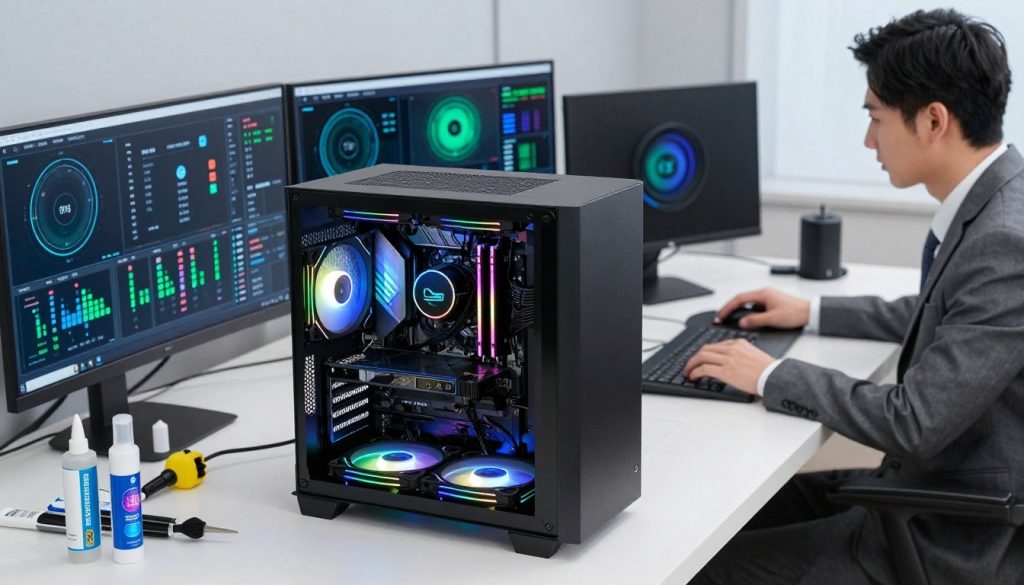
Keeping your workstation cool is key to its long life. When you run complex AI tasks, your hardware gets hot. It’s important to keep it cool to avoid damage.
Regular maintenance keeps your machine reliable for your projects. This way, it stays a trusted tool for your work.
Monitoring Thermal Throttling
Rendering tasks can make your GPU and CPU very hot. It’s crucial to manage heat to stop your hardware from slowing down. This is called thermal throttling.
Use tools like HWMonitor or MSI Afterburner to watch your temperatures. If they get too high, adjust your fan settings for better cooling. Also, make sure your computer case has good airflow.
Clearing dust from vents helps a lot. It improves how well your computer cools itself.
Managing Storage Space for Large Model Files
AI models are huge, taking up lots of space. A full drive slows down your system. It’s smart to clean out old files regularly.
Move your models to a fast NVMe SSD. This keeps your main drive free. Organizing your files helps you see what’s taking up space. A tidy storage area is good for your system’s health.
Conclusion
To reach the top in AI image making, you need the right mix of hardware and software. This summary shows how important it is to manage your digital space well. Keeping your system healthy and tweaking settings lets you control your creative work.
You know how to spot problems in Automatic1111 or ComfyUI. Keeping your GPU drivers and storage up to date stops common issues. Changing your sampling steps or VAE settings can make a big difference in how good your images look.
Use these tips to make your work easier and faster. Being able to fix tough problems means you can keep creating without trouble. Try out new models and LoRA mixes to find what works best for you. This summary is your guide to doing well in AI for a long time.
FAQ
Why is my VRAM filling up so quickly during high-resolution generations?
VRAM exhaustion is common with high-end models like the NVIDIA RTX 3060 o 4070. To solve this, use command-line arguments like –medvram o –lowvram in your Automatic1111 webui-user.bat file. Also, try Tiled VAE extensions to process images in smaller chunks. This prevents “Out of Memory” errors that stop your work.
What are the primary steps for ai porn troubleshooting when generations fail to start?
For solución de problemas de porno ai, first update your Python environment and Git repositories. Clearing your browser cache and the “outputs” folder can help. Also, check that your safety checkers aren’t blocking your Stable Diffusion installation.
How can I significantly increase my render speed without buying a new GPU?
To speed up rendering, install Xformers for better memory attention. This can increase generation speed by up to 20%. Use faster samplers like Euler a o DPM++ 2M Karras and reduce sampling steps to 20-25. High step counts slow down your work.
Why do my images appear with washed-out colors or gray distortions?
This issue is often due to a missing or wrong VAE (Variational Autoencoder). For top results, use the vaae-ft-mse-840000-ema-pruned para SD 1.5 models, or the right SDXL VAE. Fixing this in your Settings tab will fix color and clarity issues.
Is local processing better than using cloud services like RunPod or Google Colab?
Local processing on an NVIDIA RTX 4090 is best for privacy and speed. But, cloud services like RunPod offer huge GPUs for fast ComfyUI workflows. If your local setup is slow, cloud services can help.
How do I resolve conflicts when using multiple LoRAs simultaneously?
Using multiple LoRAs can cause “fried” images if total weights are over 1.0. Lower each LoRA strength to 0.4 o 0.6. Also, make sure all LoRAs work with your base checkpoint; running an SDXL LoRA on a Stable Diffusion 1.5 model will fail.
How can I prevent my system from thermal throttling during long generation sessions?
Long AI sessions can overheat your GPU. Use MSI Afterburner to watch temperatures and adjust fan settings. Good airflow in your PC case is key for fast rendering and safe hardware during long sessions.
What should I do if I experience frequent API connection timeouts?
API timeouts often mean network issues or firewall blocks. If using Automatic1111 as a backend, make sure your –api flag is on. Also, check your Ethernet connection to avoid mid-generation drops.